
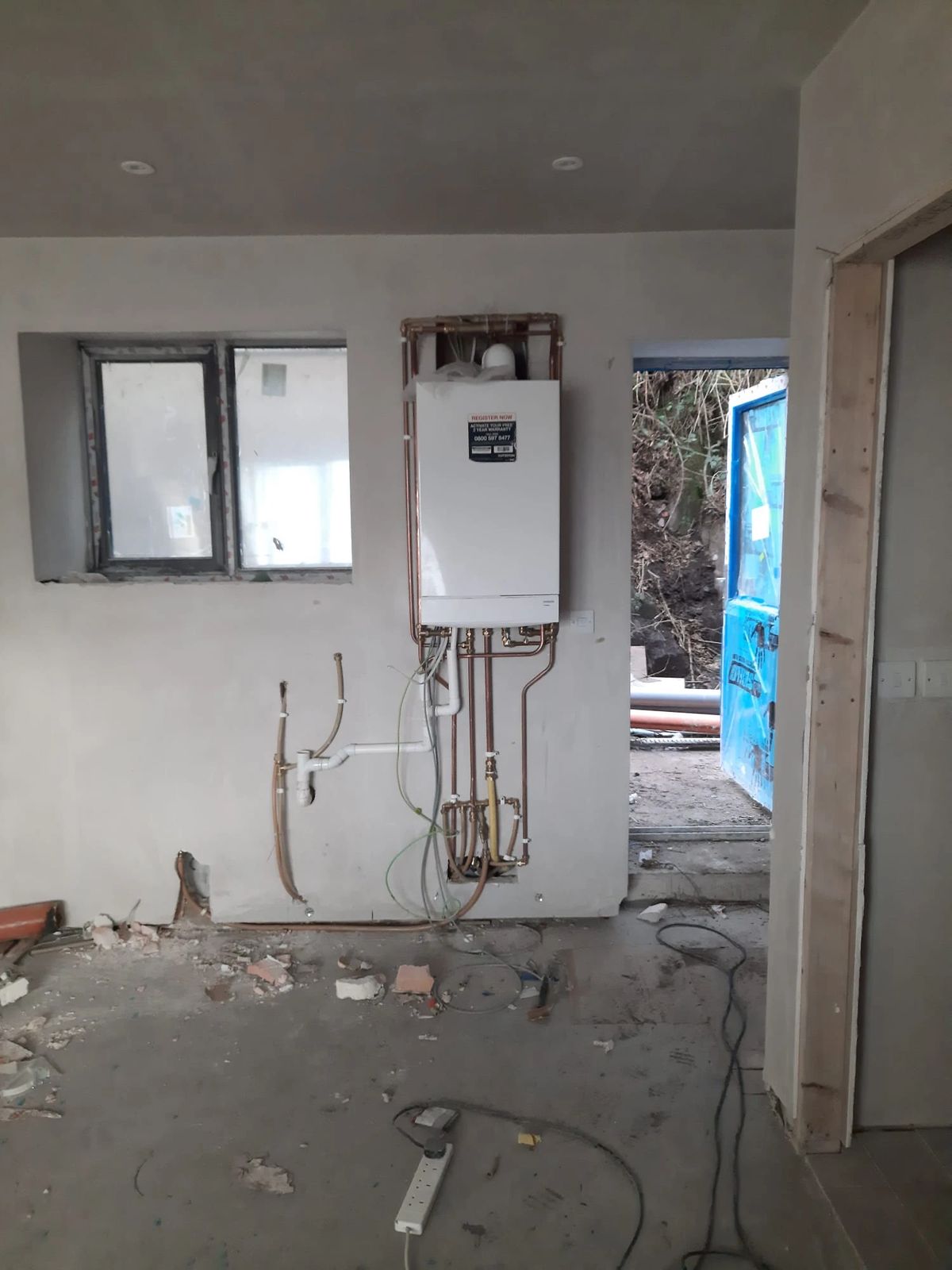
Does a boiler losing pressure mean I need a new boiler?
Not necessarily. A typical call: "I topped it up yesterday, and this morning it's dropped again. Does that mean I need a new boiler?" A lot of the time, the boiler itself isn't the problem. Some causes are straightforward to sort out. Others take a bit of investigating.
What pressure should my boiler be at?
Sealed central heating systems keep the water under pressure. When the system is cold, you generally want around 1 to 1.5 bar on the gauge, depending on the manufacturer's instructions, rising a little as the water heats up. If it keeps dropping towards zero, or you're constantly topping up to get heat, something isn't right.
Is there a small leak in the heating system?
One of the first things I'd check. A leak can be a tiny drip from a radiator valve, a pipe fitting or a connection under the boiler, small enough to evaporate while the heating runs.
In a house in Douglas with ten radiators, one valve leaking a few drops a day might never show on the floor, but over time that water loss drops the pressure. I'd check radiator valves, visible pipe joints, bleed screws and anywhere there's moisture or staining.
Is it the expansion vessel?
Many boilers have an expansion vessel inside to take up the expansion of the water as the heating gets hot. If it loses its air charge or the internal diaphragm fails, the pressure rises too high with the heating on, the safety relief valve releases water, and the pressure drops again as the system cools.
The classic sign: around 1 bar cold, rising towards 3 bar with the heating on, then very low once everything cools. That has me checking the expansion vessel and pressure relief valve before anything else.
Is the pressure relief valve leaking?
Every sealed system needs protection against excessive pressure. The pressure relief valve (PRV) releases water if the pressure gets too high, but sometimes it doesn't reseal after opening, or it develops a fault. That can leave a trickle from the discharge pipe outside the house that you mightn't notice at all.
So I'd ask: "Have you noticed any water dripping from a pipe coming out of the wall near the boiler?" Not every outside pipe is the PRV, though. A condensing boiler's condensate drain normally discharges water while it's operating, so we'd identify the correct pipe before jumping to conclusions.
Did the pressure drop after bleeding radiators?
If you bled a few radiators that weren't heating properly, letting out trapped air and maybe a little water, a pressure drop afterwards is not unusual on a sealed system. You may simply need to bring it back to the manufacturer's recommended level using the proper filling procedure.
Bleeding radiators every couple of weeks and constantly losing pressure is a different story. I'd want to know why air keeps getting into the system.
Could the leak be inside the boiler?
If every radiator and visible pipe is dry, I'd look more closely at the boiler itself. Depending on the make and model, the leak could be an internal connection, an automatic air vent, a heat exchanger or another component, and some leaks only show when the boiler is hot. That needs a qualified heating engineer, not you taking the boiler casing apart.
How do you find the cause?
A homeowner in a three-bedroom semi in Ballincollig tells me: "The boiler works grand once I top up the pressure, but every two or three days it's back down again." I wouldn't jump to a new pump, expansion vessel or boiler. I'd want to see what the pressure is doing.
| What I'm seeing | What I'd suspect |
|---|---|
| Pressure drops gradually over several days | A small water leak somewhere |
| Pressure shoots up when the heating comes on, then drops when cold | Expansion vessel or relief valve issue |
| Water dripping from the PRV discharge pipe | Pressure relief valve opening or leaking |
| Pressure dropped after bleeding radiators | Water or air released during bleeding |
| Pressure keeps dropping with no visible leaks | Hidden pipework leak or internal boiler fault |
Finding the cause matters more than simply topping up the pressure.
Can I keep topping up the pressure?
I'd never recommend topping up a leaking system every day and ignoring the problem. The heating runs again for a while, but nothing is fixed.
Fresh water can introduce more oxygen and minerals, which contribute to corrosion and sludge. With an expansion vessel fault, topping up pushes the pressure too high again when the heating comes on. A relatively small repair can become a much bigger job.
What can I check before calling a plumber?
- Check the pressure gauge when the heating is cold: Make a note of the reading.
- Watch what happens when the heating comes on: Does it rise a little, or shoot right up towards 3 bar?
- Look around your radiator valves and visible pipes: Check for damp patches, drips or signs of corrosion.
- Check whether a discharge pipe outside is dripping: Don't touch or block the pipe, as discharged water can be hot.
You can do all of these safely without opening the boiler. If pressure keeps falling, arrange an inspection rather than repeatedly refilling the system. For gas boiler work in Ireland, use a Registered Gas Installer (RGI).
Is a boiler losing pressure serious?
A boiler shouldn't need topping up every few days.
Not always. It can be a small leak at a radiator valve or pressure lost after bleeding. It can also be a faulty expansion vessel, a leaking pressure relief valve, an internal boiler problem, or occasionally a leak under the floor, which is more awkward to find. A very occasional adjustment may be normal, but regular pressure loss needs investigating.
Before I'd pick up my tools, I'd ask: does the pressure drop while the heating is off, or does it shoot up when the heating comes on and fall back afterwards? The answer tells me an awful lot about where to start looking.